

6 min read

How We Evaluate AI Startups Before We Invest: The 3 Metrics We Track

How We Evaluate AI Startups Before We Invest: The 3 Metrics We Track
5:15

A pitch deck lands in your inbox on a Tuesday morning.

The founder has the kind of CV that makes people pay attention. Revenue is moving in the right direction. A couple of respected investors are already on the cap table. By the time you've skimmed the first few slides, it's easy to feel as though someone else has already done the hard work of deciding this is a good company.

Sometimes that's true but quite often, it isn't.

One of the stranger things about early-stage investing is that the signals most people instinctively trust are often the easiest to manufacture. What’s more, at the earliest stages, you're investing long before the outcome is obvious. You're trying to work out whether a business has the foundations to become something meaningful with only a few meetings, a pitch deck and a handful of numbers to guide you.

Which is why, over time, we've found ourselves paying less attention to the obvious signals and more attention to a small number of metrics that tell us how a company is actually behaving beneath the surface.

Let’s get into it.

The Current Metrics Most Investors Track

Most investors aren't looking at wildly different things.

You open a deck, and your eyes naturally gravitate towards the same handful of signals. Who are the founders? Have they built or exited before? Did they spend time somewhere with a strong reputation? Is revenue growing quickly? Does the product feel genuinely impressive when you see it? How many users have they attracted, and who's already invested?

None of those are bad questions. In fact, they're exactly the questions you'd expect a sensible investor to ask (we ask them too!)

They're also practical. When you're working through dozens of opportunities, these are the signals that are easiest to compare. They give you a way of sorting companies quickly before deciding which deserve a deeper look, and they offer some reassurance that the market has already started to validate what you're seeing.

The difficulty comes when that first pass becomes the whole investment thesis.

Why This Checklist No Longer Works

The reason this checklist worked for so long is that it rewarded things that were relatively difficult to manufacture. Building software was expensive, distribution was slower, and product development took time.

AI has changed some of those assumptions.

Today, impressive-looking products can be built much faster, user growth can be accelerated with capital, and features that once looked differentiated can become table stakes within months. The pace of change means yesterday's moat often becomes tomorrow's expected feature.

We’d like to caveat here that none of this means traditional metrics are useless. It just makes them much weaker indicators of long-term quality than they used to be.

Take a founder's background, for example. Spending time at a great company almost always counts for something. They'll have seen good decisions made, worked alongside talented people and, if they're fortunate, experienced what real scale looks like.

But that's not the same as proving they understand the problem they're now trying to solve well enough to build a company around it.

Growth has a similar blind spot. We all like to see a chart heading upwards, but early growth is often a reflection of how a company is spending today's capital, not whether it has found something that will sustain itself tomorrow. And valuation multiples can be even more misleading. They tell you what the market was willing to believe at a particular moment in time, not whether that belief will survive once the business faces real competition.

A Better Test

So if those signals only tell part of the story, what should you be looking for instead?

It all boils down to one question: If a better-funded competitor decided to build this tomorrow, what would they struggle to replicate?

Money can buy engineers. It can buy distribution. Given enough time, it can even buy a remarkably similar product. What it's much harder to buy are the things that have been built over years: hard-won knowledge, trusted customer relationships and data that becomes more valuable every time the product is used.

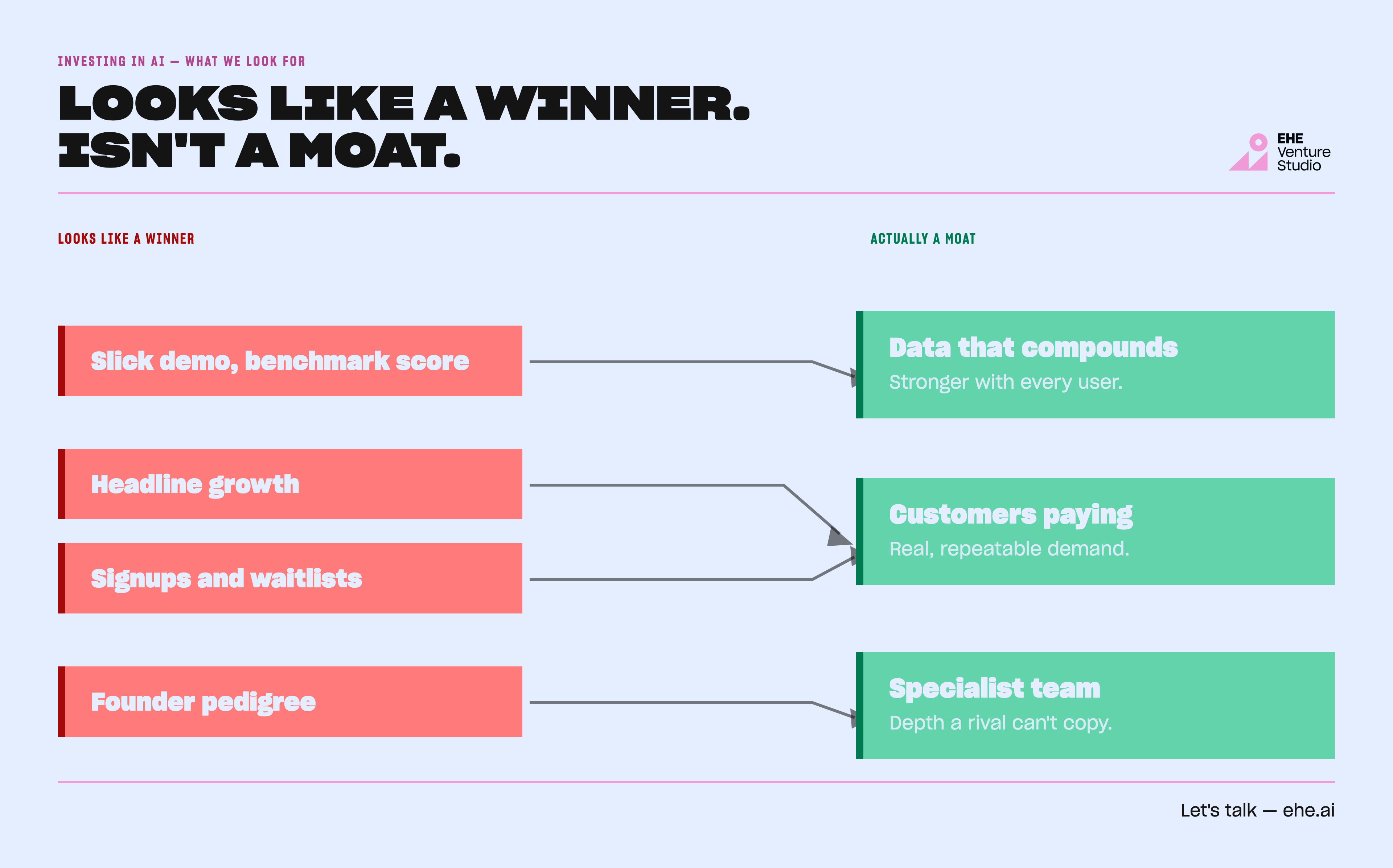
Over time, we've found ourselves returning to three core metrics in particular:

  1. A proprietary data advantage that compounds the more the product is used.
  2. A pipeline of customers already paying to solve the problem.
  3. And a founding team with deep expertise in a specific domain that would be difficult for someone else to recreate.

EHE-fakeable-vs-durable-metrics

Metric one: data that compounds

The first thing we pay close attention to is whether a company is creating something that becomes more valuable every time a customer uses it.

That might sound obvious, but it's surprisingly rare.

A lot of AI products can produce an impressive first demo mainly because the underlying models are becoming more accessible, open-source models continue to improve, and the technical gap between competitors isn't what it was even a couple of years ago. Building something clever is still difficult, but it's no longer enough on its own to create a lasting advantage.

The businesses that catch our attention are usually collecting proprietary data that nobody else has access to, and that data is feeding back into the product in a way that genuinely improves it over time. Every new customer makes the next customer's experience a little better. Every interaction teaches the system something a competitor can't simply scrape or license.

That's a very different kind of advantage.

When we're assessing a company, we're less interested in asking whether the model is the best we've seen today. Today's best model rarely stays that way for long. What we really want to understand is what happens after twelve months, or twenty-four. Does every new customer widen the gap between this company and everyone else, or does the product stay broadly the same while competitors steadily catch up?

We're also interested in how that advantage is protected as the business grows. If the data can be easily replicated, licensed by everyone else or gradually becomes commoditised, then it was probably a head start rather than a moat.

Metric two: customers already paying

The second thing we look for is the simplest, and the hardest to fake: are customers already paying to solve this problem?

It's worth remembering that most startups die not from weak technology, but from building something nobody needed badly enough to pay for. In CB Insights' analysis of startup post-mortems, product-market fit or "no market need" is one of the most common reasons for failure, just below running out of cash.

Paying customers are the cleanest evidence you're not walking into that. While signups, waitlists, and even letters of intent are great, ultimately, they cost nothing and don’t necessarily indicate commitment from users. The moment money changes hands, even for a small pilot, you've learned something no amount of interest can tell you: the problem is real, it's urgent, and someone has decided it's worth spending budget on now rather than later.

Even then, we don't stop at the headline number.

We're interested in where those customers came from. Would someone outside the founder's network have found and bought the product? Are customers renewing because they're seeing genuine value, or because the initial engagement was heavily discounted? Is there a repeatable way of finding the next customer, or does every sale rely on a warm introduction?

Those questions tell us far more about the health of a business than the total number of users ever could.

Metric three: founders who are hard to replace

The final thing we look for is much harder to measure, but it's often the reason we invest.

Every investor says they back founders. The question is what they're really looking for.

We’ve noticed that the more exceptional founders tend to have spent years immersed in a particular problem. They've worked inside the industry they're trying to change. They understand the quirks that outsiders miss, they know how decisions are really made, and they've earned the trust of the people they're now selling to.

That's surprisingly difficult to compete with.

A well-funded rival can hire engineers, spend heavily on marketing, and can even build a similar product. What they can't do overnight is recreate years of accumulated relationships, credibility and domain knowledge.

These *exceptional* founders don't just build better products. They also tend to make better decisions because they can spot opportunities earlier, avoid problems that others don't see coming, and have a much clearer instinct for what customers actually need next.

For us, that's every bit as valuable as the technology itself.

How we put this to work

If there's a common thread running through these three ideas, it's this: we're looking for advantages that become stronger over time.

Proprietary data becomes more valuable as more customers use the product. Paying customers validate not only that a problem exists, but that someone believes it's worth solving today. Deep domain expertise helps founders keep making the right decisions long after the first product has shipped.

These advantages don't always make the most exciting demo, and they don't guarantee success but they're much harder to manufacture than a polished pitch deck.

That's the lens we try to apply whenever we evaluate a company, and it's also the philosophy behind how we invest at EHE. By the time an opportunity reaches our fund, it has already been through the same conversations and diligence we'd want for our own capital.

Join us as we build and back the next wave of UK AI leaders.